

Mosquito season is back in Cincinnati — and so are the myths. Every summer, homeowners reach for citronella candles, bug zappers, and dryer sheets, convinced they’re protecting their families. Most of them aren’t. Mosquito misinformation spreads faster than the insects themselves, and believing the wrong things can leave your yard wide open.
Here are the 7 most common mosquito myths we hear from Greater Cincinnati homeowners — and the truth behind each one.
Myth 1: Citronella Candles Keep Mosquitoes Away
Citronella candles are the most popular DIY mosquito “solution” on the market — and one of the least effective. Studies have shown that citronella candles provide minimal protection against mosquito bites, and only within a very small, immediate radius. The moment you step away from the flame or the wind shifts, the effect disappears entirely.
Citronella oil — when applied directly to skin — does provide some short-term repellent effect. But the candle version? It’s largely atmosphere. Nice for a dinner party, not reliable for protecting your family from mosquito-borne illness.
The truth: EPA-registered repellents containing DEET, picaridin, or oil of lemon eucalyptus applied directly to skin are the only proven personal repellents. For yard-wide protection, a professional barrier spray is the only approach that actually reduces mosquito populations.
Myth 2: Bug Zappers Are Effective Against Mosquitoes
Bug zappers are deeply satisfying — there’s something about that crackle that feels productive. But research consistently shows that mosquitoes are not significantly attracted to UV light. The vast majority of insects killed by bug zappers are harmless or beneficial — moths, beetles, and other non-biting insects that play an important role in local ecosystems.
One University of Notre Dame study found that only a tiny fraction of insects killed by bug zappers were actually mosquitoes. Meanwhile the zapper does nothing to address the mosquito population breeding in your yard.
The truth: Bug zappers are not effective mosquito control. They’re satisfying theater with minimal impact on the insects that actually bother you.
Myth 3: Mosquitoes Are Only Active at Dawn and Dusk
You’ve probably heard to avoid being outside at dawn and dusk during mosquito season. While it’s true that many common mosquito species — including the ones that carry West Nile Virus — are most active during these low-light periods, that’s far from the whole story.
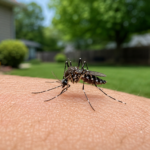
The Asian Tiger Mosquito (Aedes albopictus), which has been steadily expanding its range into Ohio, is an aggressive daytime biter. It’s active throughout the day, bites low to the ground, and is notoriously difficult to avoid. If you’re seeing mosquitoes during the middle of the afternoon, Asian Tiger Mosquitoes are likely the culprit.
The truth: Mosquito activity varies significantly by species. Assuming you’re only at risk at dawn and dusk leaves you vulnerable for the majority of the day.
Myth 4: Eating Garlic or Vitamin B Repels Mosquitoes
This one has been circulating for decades. The idea is that consuming garlic or high doses of Vitamin B1 (thiamine) changes the way you smell to mosquitoes, making you less attractive as a target. It’s a compelling theory — and completely unsupported by scientific evidence.
Multiple controlled studies have tested both garlic consumption and Vitamin B supplementation against mosquito attraction. Neither produced any meaningful reduction in mosquito bites compared to a placebo. The same goes for popular folk remedies like drinking apple cider vinegar or taking certain herbal supplements.
The truth: What attracts mosquitoes is primarily carbon dioxide, body heat, and certain skin compounds — none of which are meaningfully altered by diet. Don’t waste your money on supplement-based repellents.
Myth 5: A Bat House Will Solve Your Mosquito Problem
Bats are genuinely impressive insect hunters, and installing a bat house is a great way to support local wildlife. But the idea that bats will significantly reduce the mosquito population in your yard is a myth.
Research has shown that while bats do eat mosquitoes, mosquitoes make up a very small percentage of their diet — typically less than 1%. Bats are opportunistic hunters and will eat whatever flying insects are most abundant, which usually means larger, easier-to-catch moths and beetles. A bat house is good for bats and good for your garden. It is not a meaningful mosquito control strategy.
The truth: Bats won’t solve your mosquito problem. Enjoy them for what they are — fascinating wildlife — but don’t count on them for yard protection.
Myth 6: Only Standing Water on Your Property Breeds Mosquitoes
Eliminating standing water on your property is absolutely important — and we always recommend it. But the idea that controlling water sources on your land is sufficient to eliminate mosquito problems misunderstands how mosquito populations work.
Mosquitoes are strong fliers and can travel significant distances — some species up to several miles — from their breeding site to where they feed. The mosquitoes biting you in your backyard may have hatched in a neighbor’s neglected bird bath, a drainage ditch down the street, or a retention pond in your neighborhood. You have no control over those sources.
The truth: Eliminating standing water on your property reduces your contribution to the local mosquito population and removes close breeding sites. But it alone won’t protect your yard from mosquitoes breeding nearby.

Myth 7: Mosquitoes Don’t Really Carry Diseases in Ohio
This is the most dangerous myth on the list — and unfortunately one of the most common. Many Greater Cincinnati homeowners assume that mosquito-borne illness is something that happens in tropical climates, not in Ohio. It’s a costly misconception.
West Nile Virus is confirmed in Ohio every single year. La Crosse Encephalitis — a disease that disproportionately harms children — is consistently among the highest reported in the nation in Ohio and surrounding Midwestern states. Eastern Equine Encephalitis, while rare, has also been documented in the state.
Mosquitoes in Greater Cincinnati are not just a nuisance. They are a genuine public health concern, and treating them as such is the responsible approach for any family with children, elderly members, or immunocompromised individuals.
The truth: Ohio is an active mosquito-borne disease state. Protecting your family isn’t an overreaction — it’s the right call. Read our full guide on mosquito-borne diseases in Ohio to learn more.
So What Actually Works?
Cutting through the myths leaves you with a clear, evidence-based approach to mosquito protection:
For personal protection: EPA-registered repellents applied to skin (DEET, picaridin, or oil of lemon eucalyptus). Reapply as directed.
For your yard: Eliminate standing water sources on your property. Keep vegetation trimmed. And for season-long population control, a professional barrier spray program is the only approach proven to dramatically reduce mosquito populations around your home.
Delhi Pest Control’s Mosquito Barrier Spray Program treats the resting and breeding zones mosquitoes use throughout your yard — monthly, all season long, safe for kids and pets. Don’t let the myths leave your family unprotected this summer.
Ready to get ahead of mosquito season? Text or call Delhi Pest Control to schedule your first treatment.
Delhi Pest Control serves Delhi Township and the Greater Cincinnati area. Licensed and insured.